
How AI Skin Analysis Works (And How Accurate It Really Is)
A plain-language look at what happens when AI reads your selfie — the signals it measures, why calibration matters, and where the limits are.
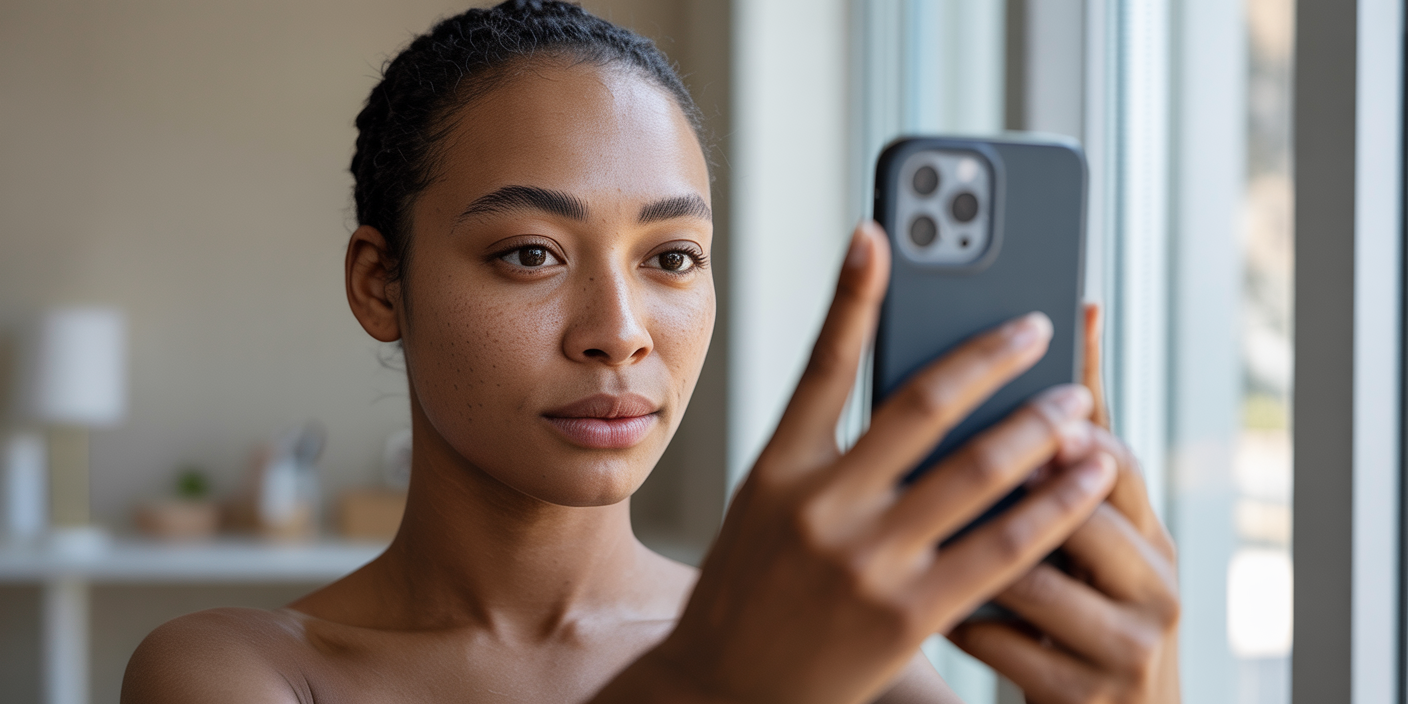
AI skin analysis sounds like magic, but it is really just careful pattern-reading. You take a clear selfie, and a vision model looks at thousands of tiny visual cues across your face. Then it turns those cues into numbers you can actually use. Here is what is happening under the hood — in plain language.
Step 1: Your photo becomes data
The first job is finding your face. GlowLog maps facial landmarks — the corners of your eyes, the bridge of your nose, your jawline — and uses them to divide your face into zones like forehead, cheeks, under-eyes, and chin. Each zone is analyzed separately, because your forehead and your cheeks rarely behave the same way.
Step 2: The AI measures signals, not opinions
Within each zone, the model estimates a set of visual signals:
- Tone evenness — how uniform your color looks across a zone
- Texture — smoothness versus visible roughness or congestion
- Hydration cues — how light reflects off well-moisturized skin
- Dryness cues — flakiness or a matte, tight appearance
- Pigmentation signals — dark marks and post-inflammatory spots
- Radiance — that lit-from-within glow
These signals roll up into your Glow Score, a single 0–100 number that summarizes the moment.
Step 3: Calibration — the part most tools skip
Here is the catch: a lot of skin AI was trained mostly on lighter skin. That bias makes it read natural melanin warmth as "redness" and penalize deeper skin for being deep. GlowLog is built differently. It detects your skin tone on two scales — Fitzpatrick I–VI and the Monk Skin Tone 1–10 scale — and recalibrates every metric for your tone. That is what we call Melanin-Aware AI Beauty, and it is the difference between analysis that works for everyone and analysis that only works for some.
Step 4: Context makes it smarter
A single selfie is a snapshot. The real value comes from comparison. GlowLog stores your check-ins and builds a personal baseline, so today's reading is compared to your last week and last month — not to a stranger. It can also factor in your logged routine, sleep, stress, and weather to explain why your skin shifted.
How accurate is it, really?
Honest answer: AI skin analysis is excellent at tracking relative change over time and good at flagging patterns you cannot see day-to-day. It is not a diagnosis. Lighting, camera quality, and angle all affect a reading, which is why consistency matters more than any single score. Take photos in similar light, around the same time of day, and the trend line becomes genuinely reliable.
- Great at: trends, zone-by-zone comparison, spotting what is improving or slipping
- Good at: surfacing likely triggers when paired with routine and lifestyle logs
- Not designed for: diagnosing medical conditions — see a dermatologist for anything concerning
Getting the most accurate reading
- Use soft, even, front-facing light — a window works beautifully
- Clean lens, steady hands, face filling the frame
- Bare skin when tracking skin health; logged makeup when checking looks
- Log consistently — the AI gets sharper the more it learns your face
Curious to see your own numbers? Explore AI Skin Analysis or read how each check-in becomes a Glow Report.
See your skin’s story clearly.
Track hydration, texture, pigmentation, tone evenness, and glow over time with melanin-aware AI built for every shade.